NEXT AUCTION: 17th March → Register to bid


What is Section 8?
Section 8 is the legal process that landlords use to regain possession of their rental property for a specific reason, for instance, a breach of contract or a change of the landlord’s circumstances.
When seeking possession of a tenanted property, landlords must use either Section 8 or Section 21 under the 1988 Housing Act.
DISCLAIMER: This article is for informational purposes only and does not constitute legal advice in any capacity. Please consult with solicitors and/or eviction specialists when seeking repossession of your rental property.
Grounds
A Section 8 notice is served on a specific ground, and if the tenant does not fix the issue or vacate, the landlord goes to court for a possession order.
Section 8 is composed of grounds or ‘reasons’ why the landlord is seeking possession. These range from rent arrears to breaches of tenancy agreement, to anti-social behaviour.
These grounds fall into two categories: Mandatory and Discretionary:
- Mandatory Grounds are circumstances where the court must grant possession if the ground is proven. For example, serious rent arrears or anti-social behaviour.
- Discretionary Grounds are circumstances where the court may grant possession if it is reasonable, for example, property damage and tenancy agreement breaches.
Because discretionary grounds do not guarantee possession, they are often served alongside mandatory grounds for increased security where possible.
Section 8 vs. Section 21
Landlords rely on two legal processes to regain possession of their rental property: Section 8 and Section 21.
Section 21 is known as a ‘no-fault eviction’ as it doesn’t need grounds or a reason to be served and can be used after four months of occupancy.
Section 21 doesn’t require evidence and is often faster than Section 8, as there is a paper-based process which doesn’t require a court hearing.
For many landlords, Section 21 has always been the primary route for seeking possession as it’s much less complicated than Section 8 and forgoes the necessity to submit evidence and attend a court hearing.
However, with the Renters’ Right Act removing Section 21, Section 8 will become the only route for landlords to regain possession of their tenanted property.
Timescales
Once the notice period has expired, the speed of the possession case is at the mercy of the courts and how backlogged they are.
Notice period – Instantaneous to two months
The process of Section 8 begins by serving a valid notice and waiting for it to expire; notice periods change depending on the ground and can be instantaneous or up to two months.
Court Proceedings – 4-8 weeks
If the tenant does not leave the property or settle the issue, the landlord then applies to the court for a possession order, which, under ideal circumstances, should take 4-8 weeks.
Possession order – 14 days (Can be extended to 42)
When the court grants possession, a possession order will be granted, lasting usually 14 days; however, the judge can extend this to 42 days in cases of hardship.
Bailiff enforcement – 5-10 Weeks
If, after that, the tenant still does not vacate the property, bailiffs must then be contacted for enforcement of the possession order; again, ideally, this should take 5-10 weeks.
Due to nationwide backlogs, this process is rarely as fast as these timescales would suggest.
In fact, between Q1-Q3 2025, the average time between claim to repossession was over 33 weeks, and this shows no signs of speeding up, especially with new legislation around the corner.
The Renters’ Rights Act is abolishing Section 21, meaning that Section 8 will be the only means of seeking possession of a rented property, which will only cause greater backlogs and strain the courts further.
Renters’ Rights Act – How will landlords be affected?
The Renters’ Rights Act (‘The act’) is coming into force from the 1st of May 2026, and is bringing some of the biggest changes to the private rental sector since the 1980s.
Some of the changes it will make include:
ABOLITION of SECTION 21
Section 21 will be defunct from the date of implementation, and any attempts to gain possession of a property using it will be deemed as unlawful.
EXPANSION of SECTION 8 GROUNDS
- Section 8 grounds for possession are being modified and amended to create a more comprehensive system of gaining possession in the wake of Section 21s abolition.
SUNSETTING of AST CONTRACTS
- Assured Shorthold Tenancies, also known as ‘fixed term’ tenancies, will no longer be recognised under the new system, and will be replaced by ‘Assured Periodic Tenancies’ (APTs).
OUTLAWING of RENT IN ADVANCE
- Landlords will no longer be able to accept rent in advance, so agreements like ‘6-months upfront’ can no longer be accepted.
LIMITATIONS on RENT INCREASES
- Rent increases will be capped to once per year, and using a Section 13 notice only. Tenants can challenge rent increases at the First Tier Tribunal at no cost and with no financial loss
RIGHT to REQUEST PETS
- Tenants will be given the right to request a pet in their property, to which the landlord cannot ‘unreasonably object’
ENDING BLANKET BANS and RENTAL DISCRIMINATION
- Landlords cannot place blanket bans on advertised properties, for example: ‘No Universal Credits’, ‘No families’, ‘No Pets’
& MUCH MORE
- Including a new PRS Ombudsman, national landlord database, Decent Homes Standard, Awaab’s Law, & Minimum EPC ‘C’.
(not an exhaustive list)
Phases of implementation
The act will be delivered in 3 phases across a long period of time.
Phase 1 – May 1st, 2026 includes:
- Abolition of Section 21
- Expansion of Section 8 Grounds
- Sunsetting of AST Contracts
- Outlawing of Rent in Advance
- Limit rent increases
- Right to request pets
- Ending Blanket Bans
Phase 2 – 2026-2028, includes:
- Introduction of PRS ombudsman, which landlords must join by 2028
- Introduction of the landlord database, starting on a regional basis from late 2026
Phase 3 – 2030 onwards, includes:
- Application of Decent Homes Standard to PRS
- Application of Awaab’s Law to PRS
- EPC ‘C’ minimum requirement to be applied from 2030
How is the act changing Section 8?
The Renters’ Rights Act is adding, modifying, and removing existing grounds – bringing the new total number of grounds to 37.
These modifications were made to ensure that Section 8 can be fully comprehensive and reliable once no-fault evictions are removed.
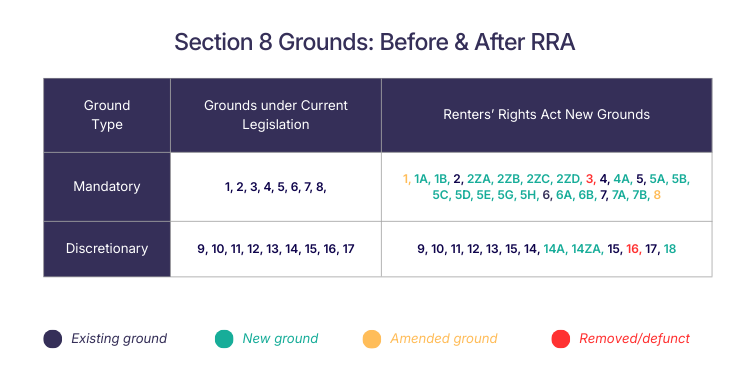
Here is a list of the updated Section 8 grounds. You can see that the majority of new grounds are mandatory, which is preferable, as a court must grant possession as discussed earlier.
What to know before serving Section 8 notices
Section 8 is tougher to serve than Section 21, because a landlord must prove a ground with evidence.
It requires a reason for the tenancy to be ended, usually a breach of contract, or a change in circumstances. On top of this, there are many other variables to consider, such as:
- Using valid and accurate grounds
- Whether the ground is mandatory or discretionary
- Using the correct notice periods
- Ensuring notice has been served correctly
- Using the correct form
- Accumulating sufficient evidence to support the case
- Is the tenant in breathing space
The bottom line: Section 8 has more pitfalls than Section 21, so it’s highly advisable to work with a legal professional – ideally an eviction specialist – to avoid costly delays or having the case thrown out altogether.
Prevent having to serve Section 8
“An ounce of prevention is worth a pound of cure”
The best way to avoid using Section 8 is to prevent needing it in the first place.
How can you do this? Well, it all comes down to improving your management system as a landlord.
By thoroughly referencing potential tenants, you’ll be able to choose the best fit for your property.
By proactively managing the property and communicating on any reported issues from the tenant(s), they will be less likely to breach the terms of their tenancy.
And by trying to solve issues with your tenants amicably instead of heading straight to Section 8, tenants will want to work with you to find a harmonious solution.
Again, even if you’ve served Section 21s in the past, Section 8 is a different story, so if you’re seeking possession of your rental property, speak to an eviction specialist and get legal advice before acting.
This new legislation is all about ‘professionalising’ the rental sector, so now more than ever, consider using a letting agent or industry professional to align your rights and responsibilities with your strategy to get the most out of your property.